
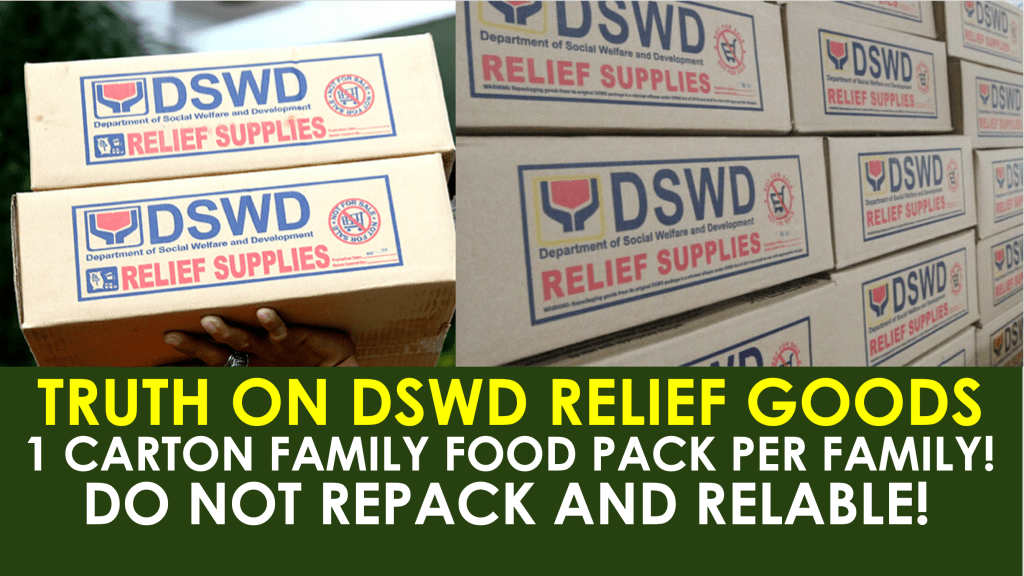
DSWD relief goods or family food pack (FFP) must not be repacked by LGUs or must not be relabelled with the name of an official or politician. 1 carton or FFP must be given to each family in whole. In accordance with Administrative Order No.2, Series of 2021, nobody is allowed to remove items, add items, or change the label of DSWD’s FFPs and NFIs to portray that it comes from another office or personality.
Every year, the Philippines experiences around 20 typhoons, some of which could lead to flooding and landslides in some areas. Being situated in the Pacific Ring of Fire, the country also faces earthquakes and volcanic eruptions from time to time. In some cases, many people get displaced, losing their homes, along with most — if not all — of their belongings.
Fortunately, in times of disaster, the Department of Social Welfare and Development (DSWD) is always ready to help. When affected local government units (LGUs) need relief augmentation, the DSWD can help provide family food packs (FFPs) as well as necessary non-food items (NFIs) to affected areas.
Who are the Target Beneficiaries?
The target beneficiaries of FFPs and NFIs are individuals, families, and communities affected by a natural or man-made disaster. To be eligible for receiving these items, the individual or family must be: (a) affected by a disaster; and (b) registered or included in the official lists of evacuation centers.
What are the Requirements?
The basis of the DSWD for providing relief augmentation is the request made by local government units (LGUs). The LGU needs to submit: (a) a letter of request; (b) a disaster or incident report indicating the number of disaster-affected people and affected areas; and (c) a master list of affected families.
And so, before anything else, be sure to coordinate with your city or municipality LGU when you need help. They shall be able to assess you and provide you and your family’s immediate needs.
What is DSWD’s Relief Augmentation?
In times of natural or man-made disasters, city/municipal LGUs and provincial governments are tasked to give basic relief assistance to affected families immediately. However, if their resources are not enough, they can seek relief augmentation from the DSWD. This involves the provision of timely and appropriate support in the form of FFPs and NFIs.
Notably, based on the department’s “disaster response operations guidelines,” each DSWD Field Office should maintain the following at any given time: 30,000 FFPs; 1,000 Family Kits; 1,000 Hygiene Kits, and PHP 3 million worth of standby fund to replenish relief resources. This way, the office is able to provide much-needed assistance when natural calamities or man-made disasters strike.
What’s in a Family Food Pack?
Have you ever wondered what’s in a DSWD Family Food Pack (FFP)? Basically, it contains rice, canned goods, and powdered drinks. One FFP caters to a family of five (5) members, and it is good for two (2) days of consumption.
Each Family Food Pack or FFP contains the following items:
- 6 kilos NFA rice;
- 2 tins canned sardines;
- 4 tins canned corned beef;
- 4 tins canned tuna flakes;
- 5 sachets 3-in-1 instant coffee;
- 5 sachets powdered cereal drink; and
- 1 piece regular slotted carton.
What Non-Food Items are Provided?
In addition to FFPs, non-food items are also provided. These include kitchen kits, hygiene kits, sleeping kits, and family clothing kits. Let us take a closer look at each set of items.
1. Kitchen Kit
Kitchen kits contain cooking tools and utensils that can be used by affected families for food preparation and consumption. Each kit contains the following items:
- 5 pieces spoon;
- 5 pieces fork;
- 5 pieces drinking glass;
- 5 pieces plate;
- 1 piece frying pan;
- 1 piece cooking pan;
- 1 piece ladle; and
- 1 piece packaging material.
2. Hygiene Kit
Meanwhile, hygiene kits include personal hygiene products and toiletries for the whole family. Each kit, which is good for one (1) month, includes the following items:
- 5 pieces toothbrush;
- 2 pieces Toothpaste;
- 1 bottle shampoo;
- 4 pieces bath bar soap;
- 2,000 grams laundry bar soap;
- 4 packs sanitary napkin;
- 1 piece comb;
- 1 piece disposable shaving razor;
- 1 piece nail cutter;
- 1 piece bathroom dipper; and
- 1 piece 20L square plastic bucket, with deep cover and plastic handle.
3. Sleeping Kit
Sleeping kits are necessary for the comfort and protection of affected families during their displacement. Each sleeping kit comes with these items:
- 1 piece blanket;
- 1 piece plastic mat;
- 1 piece mosquito net;
- 1 piece malong (wrap cloth); and
- 1 piece packaging material.
4. Family Clothing Kit
The family clothing kit includes brand new clothes, towels, and underwear garments for children and adults. Here is a list of items that are included in each family clothing kit:
- 5 pieces bath towel;
- 2 pieces ladies’ panty;
- 3 pieces girls’ panty;
- 2 pieces men’s brief;
- 3 pieces boys’ brief;
- 2 pieces sando bra, adult;
- 3 pieces sando bra, girls;
- 4 pieces adults’ t-shirt;
- 6 pieces children’s T-shirt;
- 4 pieces adults’ short pants;
- 6 pieces children’s short;
- 2 pairs adults’ slippers;
- 3 pairs children’s slipper; and
- 1 piece packaging material.
Contact Information: DSWD Central Office
If you have any questions about FFPs and NFIs, you can get in touch with the DSWD’s Central Office by contacting these details. Also presented is the Google Map to the said office:
Address: Batasang Pambansa Complex, Constitution Hills, Quezon City, Philippines, 1126
Telephone: (02) 8952-0697 or (02) 8931-8101, local 513
Website: https://www.dswd.gov.ph/
Source: DSWD

 THE CORDILLERA CONNECTION