
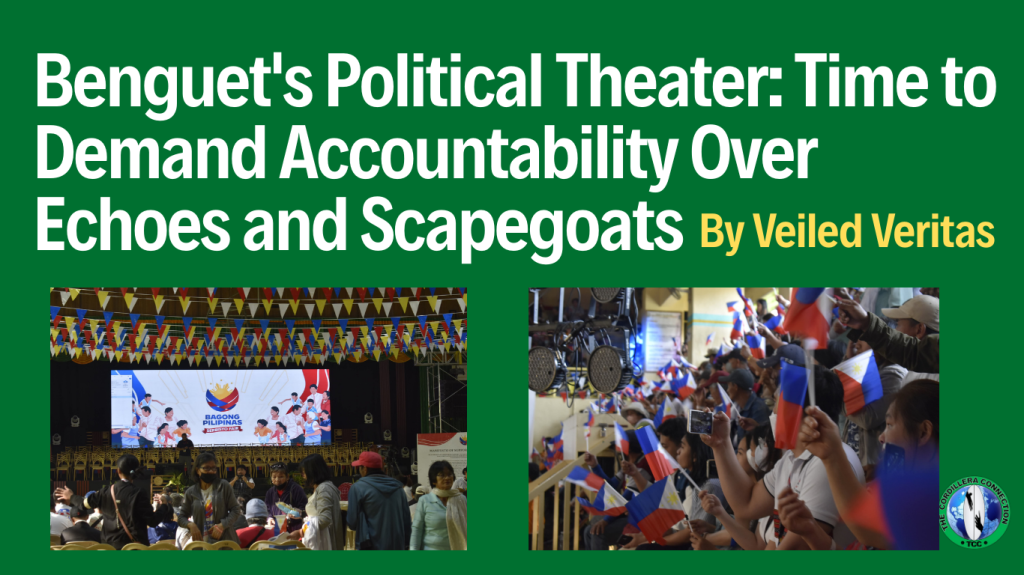
Dating back to April 21 to 22, 2024, I was one of the field journalists assigned to cover the “Bagong Pilipinas Serbisyo Fair” in Benguet State University, La Trinidad, Benguet. I witnessed firsthand the intersection of government service and political theater. The event was a sprawling affair, drawing over 50 agencies to showcase projects and initiatives, providing assistance and services to those who showed up. As a field journalist, I was given an assignment to shadow a guest from the Office of the Malacanang Palace (I’ll keep the specific agency vague to avoid obvious implications). As the program went on, we inspected sites, reviewed budgets, and engaged with local officials. It was during one of these onsite visits that I overheard a conversation between the Malacanangguest and a local official—a chat that stuck with me long after the event ended. “Tatakbo kaya si Yap sasusunod?” the guest asked—roughly, “Will Yap run again next time?” The local official’s response was cautious: “I don’t know, sir, maybe.” But the guest pressed on: “Sakit naman kase sa ulo yan siYap”—”That Yap is such a headache.” The rest of the reply faded into the background noise, but the words hit me. Why does this person have such a disliking for Congressman Yap, when he’s often hailed for his projects?
This got me digging deeper, researching his initiatives and the narratives around them. Take the TUPAD program, for instance. From what I observed, the qualifications for beneficiaries under Yap’s oversight sometimes diverged from standard barangay guidelines. I witnessed barangay officials patiently explaining the required details to applicants, only to hear grumbles like, “Ganto naman yung qualification kay Yap”—”That’s just how Yap sets the qualifications.” This discrepancy bred resentment among some local leaders, who felt sidelined. Was this a genuine effort to tailor aid, or a way to consolidate influence? It’s worth questioning, especially when government programs are meant to be equitable and transparent. And get this—I know someone from back in 2022 who enlisted for TUPAD and got selected, even though her husband is a seaman abroad. Out of all the people who really need it, why her? Maybe they just didn’t do a proper background check.
Then there’s the scholarship stuff. Yap’s office frequently posts about educational opportunities, but these are actually Commission on Higher Education (CHED) programs like the Tulong Dunong Program (TDP) and the CHED Scholarship Program (CSP), with the provincial government and TESDA chipping in too. From what I know, do they have rigorous screening? But it’s really different when it comes to students’ views. I overheard—and actually saw—students filling out CHED application papers that were often routed through Yap’s office. What, then, is the CHED regional office really doing? Is the Congressman also in charge of CHED’s work? And for TESDA, they have a free tuition with allowance program that’s widely available nationwide, but it seems all the credit goes to the congressman. Did he initiate it? Did he inject additional funds? Or is this just savvy branding, claiming credit for work that’s already government-mandated?
Don’t get me wrong; these projects are commendable. Scholarships uplift youth, and TUPAD helps the vulnerable. But when they’re government-funded, they shouldn’t be hijacked for personal glory. If Congressman Yap added his own money or pushed for implementation, that’s praiseworthy—hats off. But what if this is just a potential tactic to deceive and build trust, turning public services into political currency?
Fast-forward to the 2025 elections, where Benguet’s political scene was heating up. Social media became a battlefield, with influencers and vloggers amplifying successes and failures. Here’s what I observed during the campaign: When projects shone, the praise was singular: “Dayta ti Congressman me” (“That’s the Congressman”) or “Thank you, Congressman.” But when issues arose—like road projects or flood control in the province—the blame shifted dramatically. Comments like “Inkayo ireklamo idjay DPWH haannga ditoy Facebook” (“You should complain to DPWH, not here on Facebook”) or “Haan nga project ni Cong dayta” (“That’s not the Congressman’s project”) deflected responsibility to the Department of Public Works and Highways (DPWH), contractors, or even the municipal government. One viral post even captioned a stalled road: “Nu talaga metlang ni Tagelnga dayta ituloy na di Kalsada idjay…” (“If Tagel really wants it, let him continue the road…”). I couldn’t help but wonder: Why not hold the contractor accountable, instead of challenging a rival politician to finish it?
This selective outrage exposed a deeper flaw in politics, where credit is hoarded and blame is outsourced. Now, with allegations of anomalies swirling around Yap, social media remains ablaze till today. We still see posts about them, with comments twisting in confusion, some invoking faith: “Seek the Lord and He will give you peace.” But do they really grasp the phrase? If Yap is truly innocent, why the fear of accountability? This isn’t about blind loyalty or support for politicians—it’s about understanding how politics really works.
What exactly is a congressman’s job? Do we really understand how the President down to barangay officials operate? I’ve seen people beg barangay captains for financial or medical aid, but is that really their mandate? “Talaga bang trabaho nang Brgy. Captain mag bigay ayuda?” (“Is it really the barangay captain’s job to give aid?”) “Ganun ba ang gampaninnang isang Opisyal?” (“Is that the role of an official?”) They can refer folks to government programs, but they shouldn’t claim the credit. Claiming others’ work just erodes trust and distorts democracy.
In Benguet, we’ve seen how this plays out: projects praised as personal triumphs, failures blamed on scapegoats, and elections fought in echo chambers. As we move forward, let’s demand transparency and hold leaders accountable for their actual roles—not the whole system’s mess. Only then can we build a politics of genuine service, not just self-serving theater.
By Veiled Veritas
 THE CORDILLERA CONNECTION